COLOUR VARIANTS
Welcome to our Colour Variant section.
Saddleback
Impala
Black Impala
White Flanked
Impala
Dappled Impala
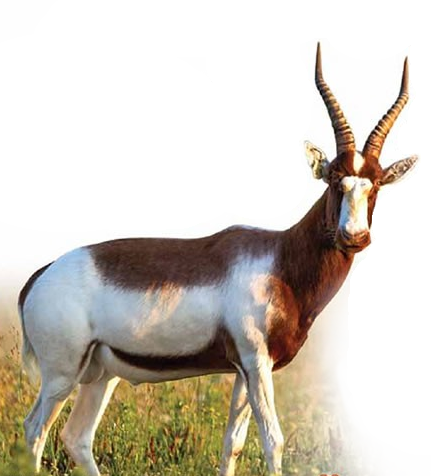
The impala (Aepyceros melampus) is a
medium-sized antelope found in eastern and southern Africa. The sole
member of the genus Aepyceros, it was first described by German
zoologist Martin Hinrich Carl Lichtenstein in 1812. Two subspecies are
recognised—the common impala, and the larger and darker black-faced
impala. The impala reaches 70–92 centimetres (28–36 inches) at the
shoulder and weighs 40–76 kg (88–168 lb). It features a glossy, reddish
brown coat.
Active mainly during the
day, the impala may be gregarious or territorial depending upon the
climate and geography. Three distinct social groups can be observed: the
territorial males, bachelor herds and female herds. The impala is known
for two characteristic leaps that constitute an anti-predator strategy.
Browsers as well as grazers, impala feed on monocots, dicots, forbs,
fruits and acacia pods (whenever available). An annual, three-week-long
rut takes place toward the end of the wet season, typically in May.
Rutting males fight over dominance, and the victorious male courts
female in oestrus. Gestation lasts six to seven months, following which a
single calf is born and immediately concealed in cover. Calves are
suckled for four to six months; young males—forced out of the all-female
groups—join bachelor herds, while females may stay back.
The
impala occurs in woodlands and sometimes on the interface (ecotone)
between woodlands and savannahs; it inhabits places close to water.
While the black-faced impala is confined to southwestern Angola and
Kaokoland in northwestern Namibia, the common impala is widespread
across its range and has been reintroduced in Gabon and southern Africa.
The International Union for Conservation of Nature (IUCN) classifies
the impala as a species of least concern; the black-faced subspecies has
been classified as a vulnerable species, with less than 1,000
individuals remaining in the wild as of 2008.
Black Kudu
The Black Kudu’s colour is from a recessive gene and is not because of inbreeding.
The
kudu (Tragelaphus strepsiceros, English: Greater Kudu) is a wild buck
prevalent in South Africa. The bull weights up to 270kg and the cow up
to 210kg. The horns of the bull can be up to 150cm long and the cow has
no horns. Between the eyes is a white chevron mark.
The
animal is usually found in typical undergrowth in bushveld regions
especially close to or on hilly terrain.
He has a ability to quietly
disappear among plants and thicket due to his ability to move without
noise while he grazes.
White Kudu
The colour of the White Kudu is from a recessive gene and is not from inbreeding. They are not albinos.
The
kudu (Tragelaphus strepsiceros, English: Greater Kudu) is a wild buck
prevalent in South Africa. The bull weights up to 270kg and the cow up
to 210kg. The horns of the bull can be up to 150cm long and the cow has
no horns. Between the eyes is a
white chevron mark.
The animal is usually found in typical undergrowth
in bushveld regions especially close to or on hilly terrain.
He has a
ability to quietly disappear among plants and thicket due to his ability
to move without noise while he grazes.
Red Waterbuck
As it name would suggest, the waterbuck is a
good swimmer and flees into water if pursued, although it is reported
that they do not actually like going into water. At 7-9 months, males
are driven from their maternal family and join up with a bachelor herd.
These groups have a distinct social hierarchy based on size and
strength, and contests are frequent. Around 6-7 years, males become
territorial, staking out areas of 150-625 acres and defending them
against mature rivals with posturing and fights.
These territories are
maintained throughout the year, and a male is generally overthrown
before he reaches 10 years of age. Only about 5-10 % of mature males
are territorial at the same time. Female groups wander over a home
range of 200-600 hectares, which may be kept for up to 8 years and
encompasses several male territories. Population densities in Uganda
vary from 0.15-17.8 animals per square kilometer
Kings Wildebeest
A
king wildebeest must have a grey/blue to dark blue/black colour on his
body, similar to the colour of the ordinary blue wildebeest and darker. The tail, mane and beard must be white. King wildebeest are born with a white tail, beard and mane. The
nose and mouth around the eyes and inside the ears must be pink in
colour. This is a characteristic of all king wildebeest, although some
may be lighter pink and some darker pink. The colour of the face
of the adult king wildebeest should be mostly or completely white. At a
younger stage the face has darker shades of brown and black which will
turn lighter as the king wildebeest grows older. The king wildebeest must have a white line on its back from where the mane ends to his rump.
If the king wildebeest has a spot on his body, these spots should be identical on both sides of the animal. Note: a spot is not a requisite characteristic of the king wildebeest.
Royal Wildebeest
The Royal Wildebeest / Royal King Wildebeest (also known as ghost
wildebeest) is the most rare colour variant of all the blue
wildebeest variants.
There are an estimated 20 – 30 in the
world.
Currently there are only five breeders actively breeding with
the Royal
Wildebeest.
The colour variants are not to be confused with
subspecies, they are also not hybridised through cross breeding of the
various subspecies.
Golden Wildebeest
The first confirmed records of golden wildebeest date back as far as the
early 1930’s, when they were called “Vos Wildebeest".
The golden
wildebeest has a golden coloured face and a very light yellow/gold mane,
tail and beard.
Contact us today for top genetics.
White Blesbuck
The Blesbok or Blesbuck is a
purplish antelope with a distinctive white face and forehead. Its white
face is the origin of its name, because bles is the Afrikaans word for
blaze.
Although it is a close relative of the Bontebok and can
interbreed with it, creating an animal known as the Bontebles or Baster
Blesbok, it does not have the same habitat. The Blesbok is indigenous to
South Africa and is found in large numbers in all national parks with
open grasslands, from the Transvaal Highveld, through the Free State
veld, to as far south as the Eastern Cape.
It is a plains species and
dislikes wooded areas. It was first discovered in the 17th-century, in
numbers so numerous that herds reached from horizon to horizon.
Saddleback Blesbuck
The Blesbok or Blesbuck is a
purplish antelope with a distinctive white face and forehead. Its white
face is the origin of its name, because bles is the Afrikaans word for
blaze.
Although it is a close relative of the Bontebok and can
interbreed with it, creating an animal known as the Bontebles or Baster
Blesbok, it does not have the same habitat. The Blesbok is indigenous to
South Africa and is found in large numbers in all national parks with
open grasslands, from the Transvaal Highveld, through the Free State
veld, to as far south as the Eastern Cape.
It is a plains species and
dislikes wooded areas. It was first discovered in the 17th-century, in
numbers so numerous that herds reached from horizon to horizon.